
What Cultural Insensitivities or Trend-Chasing Pitfalls Should You Avoid in Dog Naming?
Naming a dog feels wonderfully personal, but it’s also surprisingly public. You’ll say your dog’s name at the veterinarian, the dog park, boarding facilities, neighborhood sidewalks, and on social media. That makes the stakes higher than most people realize. A name can be playful and memorable without being careless; it can honor heritage without appropriating it; and it can reflect trends without turning your dog into a short-lived meme.
This expert guide focuses specifically on dog names in the United States, where a diverse, multilingual culture and highly online pet community shape what is considered respectful, practical, and enduring. You’ll learn the cultural insensitivities to avoid, the trend-chasing traps that create long-term headaches, and a practical name-testing framework to help you land on a name that ages well—socially and functionally—for the entire lifespan of your dog. For more details, see our guide on When Should You Consider Renaming Your Dog, or Evolving Your Naming Strategy? The Art & Science of Choosing a Name.
Why Cultural Sensitivity in Dog Naming Matters More Than You Think
Dog names aren’t private nicknames in practice. They are repeated dozens of times a day in public spaces and recorded in digital systems like microchip registries, vet records, and daycare bookings. A poorly chosen name can: For more details, see our guide on “Kit, come!”.
- Offend or alienate neighbors and service providers—which can affect your dog’s access to grooming, training groups, and dog parks.
- Confuse training and safety if it sounds like commands or emergency cues.
- Age badly if it’s tied to a fleeting trend, an internet meme, or a polarizing figure.
- Signal stereotypes (intentionally or not) about cultures, communities, or breeds. For more details, see our guide on How to Leverage Current Dog Naming Trends Without Sacrificing Originality.
Annual U.S. dog-name lists from registries and pet services consistently show pop-culture spikes (TV shows, video games, movies), while shelter professionals often report that joke or meme names are among the first to be changed upon adoption. The American Pet Products Association’s 2023 National Pet Owners Survey revealed that 38% of dog owners consider their pet’s name a reflection of their own identity, making the choice even more significant in social contexts.
The takeaway is simple: your dog’s name is both a personal brand and a public broadcast. Treat it like a long-term decision that will echo through veterinary offices, training facilities, and neighborhood interactions for the next decade or more.
Where Playful Crosses into Problematic
Dogs Are Family—and Public Ambassadors
Your dog wears your decision, but everyone else hears it. What sounds clever at home can be awkward, offensive, or polarizing when shouted across a park. Professional dog trainers consistently report that owners who feel embarrassed by their dog’s name in public settings use it less frequently, which directly impacts recall training and emergency response.
A good rule: if you wouldn’t comfortably say the name to a new neighbor, a schoolteacher, or a veterinarian on speakerphone, keep looking. Here’s what most people don’t realize: your dog’s name becomes part of your social identity in your community. Dog park regulars, veterinary staff, and pet service providers will associate you with that choice for years to come.
Cultural Context Changes
Names associated with neutral things today can acquire new meanings tomorrow. For example, names once tied to ancient mythology have collided with modern geopolitical events. Social media amplifies these shifts—a name that seems harmless can become controversial overnight through viral content or news cycles.
A resilient name should withstand social shifts over the next 10–15 years—the average lifespan of many breeds—from a Siberian Husky to a Jack Russell Terrier. Consider how rapidly internet culture moves: memes that dominated 2020 already feel dated in 2024. Your dog’s name needs more staying power than a TikTok trend.
Cultural Insensitivities to Avoid in Dog Naming
Below are categories that most often result in regret, backlash, or unintended offense in the U.S. cultural context. These insights come from veterinary professionals, dog trainers, and cultural sensitivity experts who work directly with pet owners navigating these challenges.
1. Sacred and Religious Terms, Figures, or Titles: The Impact Outweighs the Intent
Using sacred words or revered figures as pet names can trivialize deeply held beliefs. This includes names for deities, prophets, sacred texts, and ceremonial terms across religions (for example, Islam, Christianity, Judaism, Hinduism, Buddhism, and Indigenous belief systems). Similarly, avoid religious honorifics like “Rabbi,” “Guru,” “Imam,” or “Saint” used as cheeky nicknames.
Even if your intent is admiration, the impact can be dismissive when attached to a pet. Religious communities often view pets differently than family members, and using sacred names can signal disrespect for theological boundaries. Veterinary clinics in diverse areas report occasional tension when staff must repeatedly use religious names for animals in front of clients from those faith traditions.
Key Insight: Even well-intentioned humor can cause unintentional offense. Focus on admiration, not appropriation. Try this approach: if the name requires explanation or defense, it’s probably not the right choice.
2. Indigenous Peoples’ Names, Ethnic Group Names, and Culturally Specific Titles: Appreciation vs. Appropriation
Using the names of Indigenous nations, tribes, or ethnic identities as dog names can be seen as reductive or appropriative. The National Congress of American Indians has specifically addressed the casual use of tribal names for pets, sports teams, and commercial products as a form of cultural diminishment.
Likewise, using culturally specific titles (e.g., terms for chiefs, elders, or royalty) carries weight you may not fully understand. When in doubt, avoid identities and roles that belong to living communities. Be especially mindful with breeds whose origins are tied to specific peoples or regions; for example, the Siberian Husky has historical links to Arctic communities whose languages and traditions deserve respect, not casual borrowing.
Appreciation is different from appropriation: choose descriptive, neutral words or learn deeply from the culture before you borrow language. The difference lies in relationship—are you connected to and accountable to the community whose language you’re using?
Key Insight: Respecting cultural heritage involves understanding, not just borrowing. When you’re drawn to a cultural name, ask yourself: am I honoring or just taking?
3. Words with Slur Histories or Stereotypes: The “Research Before You React” Rule
Some words have been reclaimed within communities; however, as a pet name, they can be alienating or hurtful in public spaces. The reclamation of language is a complex process that belongs to affected communities—it’s not transferable to pet naming by outsiders.
Avoid language connected to slurs, caricatures, or derogatory tropes about race, ethnicity, religion, nationality, gender, or sexual orientation. This includes seemingly innocent words that have acquired negative connotations through historical usage or internet culture. If you’re unsure whether a word is controversial, research the term or ask a few people beyond your immediate circle.
Key Insight: When in doubt, err on the side of caution. A simple Google search can prevent a world of potential hurt and awkwardness. What seems harmless in your social bubble might carry painful history for others.
Here’s the thing though: Choosing a dog name involves more than just gut instinct. Professional animal behaviorists emphasize that names with negative social associations can actually impact how strangers interact with your dog, affecting socialization opportunities crucial for behavioral development.
4. Historic Oppressors, Atrocities, and Tragedies
Naming a dog after notorious dictators, perpetrators of violence, or tragedies signals shock value at the expense of sensitivity. This category extends beyond obvious choices to include figures who may seem historically distant but remain painful for affected communities.
Holocaust education organizations, for instance, have documented cases where pet names trivializing genocide have caused distress in veterinary waiting rooms and dog parks. Similarly, names referencing mass suffering or events tied to collective trauma are out of bounds. Your dog is a companion, not a provocation.
The test here is simple: does the name reference human suffering or oppression? If yes, choose something else. There are thousands of positive options that don’t require explaining away historical trauma.
5. Language Borrowing Without Understanding
Foreign-language names can be beautiful and meaningful. The problem arises when the name is used just for exotic flair and ends up being a mismatch, a mistranslation, or inadvertently rude. Google Translate isn’t sufficient for cultural navigation—languages carry nuances, formality levels, and sacred boundaries that automated translation misses.
If you’re drawn to a language, learn the meaning, check pronunciation with native speakers, and avoid sacred or ceremonial words. A respectful Japanese name for an Akita or Shiba can be lovely; a misused honorific or ritual term is not. Language learning apps like Duolingo or HelloTalk can connect you with native speakers who can provide cultural context beyond basic translation.
Key Insight: Beautiful doesn’t always mean appropriate. Take the time to understand not just what a word means, but how it’s used and who has the right to use it.
6. Stereotyping Based on Breed or Looks
Names that play into breed stereotypes—like naming a Pit Bull “Killer” or a Chihuahua “Yappy”—can reinforce biases that affect housing permissions, daycare acceptance, and public perception. Breed discrimination is real and documented: certain breeds face restrictions in housing, insurance, and public spaces.
Research from the American Veterinary Medical Association shows that breed-based stereotypes influence how dogs are perceived and treated by strangers, which can impact socialization and training opportunities. A name that reinforces negative stereotypes compounds these challenges.
Remember that breed names themselves carry histories: the Jack Russell Terrier was named after Reverend John Russell; the American Eskimo Dog includes a term that many now avoid in people-centered contexts. When in doubt, choose aspirational traits (e.g., “Friendly,” “Sunny,” “Scout”) rather than labels that confirm prejudice.
Key Insight: Your dog’s name can either challenge stereotypes or reinforce them. Choose to be part of the solution by selecting names that highlight positive qualities.
Trend-Chasing Pitfalls in Dog Names
7. Meme Names with a Short Shelf Life: The 3-Year Test
How funny will a meme be in three years? Internet culture moves at lightning speed—what’s viral today is forgotten tomorrow. Trend-chasing can backfire when the internet moves on, leaving your dog with a dated reference that requires constant explanation.
Dogs with novelty names often get renamed by new owners or even by the same family after the joke wears thin. Shelter workers report that dogs with meme-based names are sometimes harder to place because potential adopters assume the pet wasn’t taken seriously by previous owners.
If your first reaction to a name is laughter rather than love, pause. Ask yourself: will this name still bring you joy when you’re calling it in the rain at 6 AM, or when you’re introducing your dog to your boss, or when you’re at the emergency vet at midnight?
Key Insight: Think long-term. Will this name still bring you joy years from now? If not, it’s best to reconsider. The “3-year test” is your friend—imagine explaining this name to someone in 2027.
8. Pop-Culture Surges: TV, Movies, Games
Annual lists in the U.S. routinely show spikes for names like “Luna,” “Arya,” “Mando,” or “Pixel” after breakout hits. The American Kennel Club’s annual name surveys consistently show 20-30% increases in character names following major TV finales or movie releases.
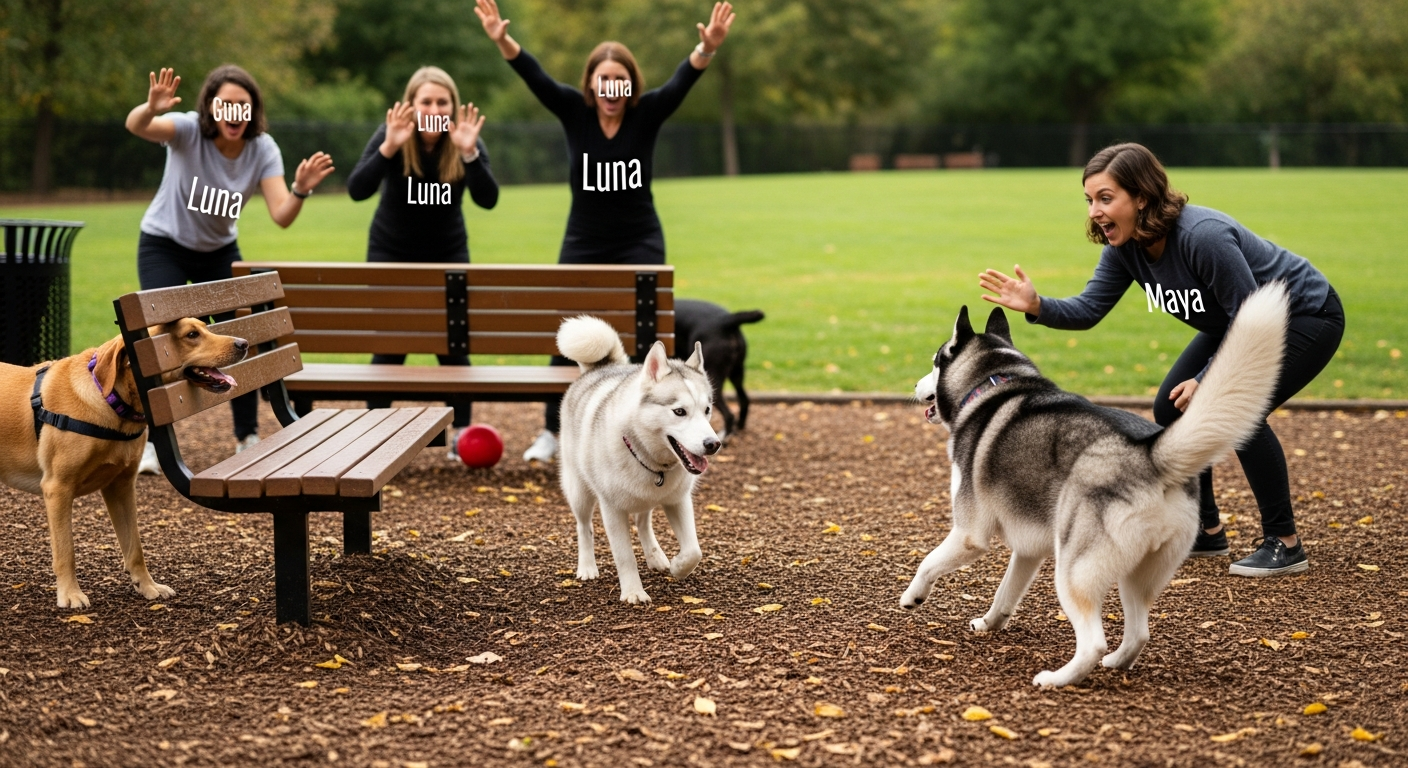
Pop culture can be a great source of inspiration, but consider uniqueness and longevity. A name that’s ultra-popular in your city can cause chaos at the dog park and in training classes when five dogs turn around at once. Professional dog trainers often joke about the “Game of Thrones classes” where half the dogs share character names.
Key Insight: Popular doesn’t always mean practical. If you love a trending name, consider a variation or wait to see if your enthusiasm lasts beyond the show’s finale.
9. Political and Polarizing Names
Even if politics is central to your identity, your dog has to navigate many environments. Names tied to political figures, movements, or slogans invite confrontation in spaces where your dog needs to be welcome and comfortable.
Trainers, pet sitters, and boarding facilities may decline clients whose pet names are likely to trigger conflict in group settings. This isn’t about political correctness—it’s about business practicality. Service providers want peaceful environments where all clients feel comfortable.
What’s interesting is that certain names can trigger unexpected emotional responses even years after political relevance fades. A name that seems clever during election season can become a liability in professional pet care settings.
Key Insight: Your dog shouldn’t have to carry your political statements. Keep advocacy and pet naming separate for your dog’s social wellbeing.
10. Brand and Trademark Names
Naming your dog after a brand is generally legal for personal use, but it can be awkward in public (“Nike, heel!”) and complicated if you later build your dog’s social media presence or merchandise. Companies may enforce trademarks if you monetize content featuring your pet, and followers may assume sponsorship where none exists.
The rise of pet influencer culture means more dogs have social media presence than ever before. A brand name that seems fun initially can create legal complications if your dog becomes internet famous. Choose something that feels like a personal identity, not a product placement.
11. Overused Names That Undercut Training
Overly common names can create miscommunication in group classes and parks. The American Kennel Club reports that names like “Bella,” “Max,” and “Luna” have dominated top-10 lists for over a decade, creating practical problems in multi-dog environments.
There’s also a practical training issue: names that sound like common commands or admonitions (“Bo” vs. “No,” “Kit” vs. “Sit”) lead to confusion. Professional dog trainers recommend names with hard consonants and distinct vowel sounds that cut through ambient noise and don’t echo training cues.
Strive for a crisp, unique sound profile that your dog can distinguish from environmental noise and other dogs’ names. Two syllables with different vowel sounds often work best for recall training.
United States–Specific Considerations
Multilingual Communities
Urban and suburban U.S. settings are linguistically diverse. According to the U.S. Census Bureau, over 67 million Americans speak a language other than English at home. A name that’s harmless in English might be offensive or silly in Spanish, Mandarin, Arabic, or another common local language.
Do a quick multilingual check, especially in major metropolitan areas. At minimum, search the word with “meaning in [language]” to ensure you’re not unintentionally choosing profanity or an awkward homophone. This is particularly important in states like California, Texas, Florida, and New York, where linguistic diversity is highest.
Key Insight: Your local community’s linguistic landscape matters. A quick translation check can save embarrassing discoveries later.
Public Spaces, Vets, and Documentation
Your dog’s name appears on vet charts, daycare rosters, training graduation certificates, social media tags, and microchip registrations. Think about how it looks in writing and how it sounds on the phone. Many clinics will use your dog’s name repeatedly in front of other clients; avoid names that put staff in uncomfortable positions.
Veterinary professionals report that they sometimes struggle with inappropriate pet names in professional settings, especially when discussing serious health issues with owners. A name that seems funny at home can feel jarring when discussing surgery options or end-of-life care.
Breed Names with Place-Based Histories
Breeds often carry geographic and cultural histories that deserve respect. The “Siberian Husky,” for example, references a region and working heritage tied to Indigenous Arctic peoples; respect that lineage when selecting culturally adjacent names.
The Jack Russell Terrier’s eponym shows how some names honor individuals in breed history—an approach that can be respectful when thoughtfully applied to pets (e.g., famous trainers, canine heroes, historical figures with positive legacies) rather than to contested cultural identities or sacred terms.
Research your breed’s origins and consider names that honor that heritage without appropriating sacred or identity-based language. This approach shows respect for the people and cultures that developed these remarkable working partnerships with dogs.
A Respectful Dog-Name Decision Framework: The IMPACT Checklist
Use this quick framework before you finalize a name. Professional dog trainers and cultural sensitivity experts recommend this systematic approach:
-
Intent vs. Impact: Even if your intent is playful, could the impact be dismissive or hurtful? If yes—or if you’re not sure—skip it. Impact matters more than intent in public spaces.
-
Multicultural Context: Would the name be acceptable in a vet waiting room, at a child’s school event, or on a public registration? Consider your community’s diversity.
-
Public Accountability: You’re choosing for a being who can’t agree to carry a joke or a controversy. Err on the side of dignity and respect.
-
Aging Test: Will the name still feel good in 10 years? Imagine saying it thousands of times across different life stages and social contexts.
-
Communication Clarity: Distinct from commands and easy for others to pronounce. Two syllables with hard consonants often work well (e.g., “Milo,” “Piper,” “Kona”).
-
Translation Check: Search the name across languages common in your area and scan for unintended meanings or offensive homophones.
Key Insight: This checklist takes 10 minutes but can save years of regret. Use it as your final filter before committing to a name.
Practical Name-Testing Checklist
Before printing tags or ordering a custom harness, run these real-world tests. Professional dog trainers swear by this practical approach:
-
The Park Shout Test: Step outside and call the name loudly five times. Does it feel comfortable? Could it be misheard as a slur or command? Would you feel confident yelling this at a crowded dog park?
-
The Vet Phone Test: Say: “Hi, I’m calling about my dog [Name].” Does it sound professional and respectful? Can you imagine discussing serious health issues using this name?
-
The Command Confusion Test: Compare your name with “Sit,” “Stay,” “Down,” “No,” “Come,” “Heel.” If it’s phonetically close (“Bo”/“No,” “Ray”/“Stay”), reconsider for training clarity.
-
The Google Scan: Search the word + “meaning,” + “slur,” + “controversy,” + “translation.” If you uncover issues, walk away. Include your local area’s common languages in this search.
-
The Family & Friends Panel: Ask three people of different ages or backgrounds for honest feedback. If any express discomfort, listen. Their hesitation often reflects broader social reactions.
-
The Future-Proofing Test: Imagine the name on a social profile, a vet invoice, a therapy dog vest, or a microchip registration in five years. Still good? Consider how it might age with changing social norms.
Key Insight: These tests simulate real-world usage. If a name fails any test, you’ll likely encounter that problem repeatedly over your dog’s lifetime.
Safer, Thoughtful Alternatives That Still Feel Special
Appreciation Without Appropriation
If you love the sound of a language or want to nod to a place, choose neutral, descriptive words with clear meanings and no sacred or ceremonial ties. This approach honors cultural beauty without overstepping boundaries.
-
Nature and Geography: “River,” “Aspen,” “Zuma,” “Canyon,” “Sierra,” “Denali” (note: even nature names can have cultural layers; research place names, especially in areas with Indigenous histories).
-
Universal Human Qualities: “Sunny,” “Noble,” “Merry,” “True,” “Brave,” “Joy,” “Hope,” “Grace.”
-
Food and Plants: “Basil,” “Cocoa,” “Miso,” “Olive,” “Clover,” “Sage,” “Pepper.” (Avoid slang that doubles as innuendo.)
-
Traits You Want to Encourage: “Scout,” “Buddy,” “Clever,” “Brave,” “Hope,” “Spirit,” “Dash,” “Quest.”
-
Gentle Pop-Culture Nods: Choose characters with enduring appeal and broad, non-controversial recognition; prefer less saturated options to avoid echoing every dog in your zip code.
Key Insight: The best names feel both personal and universal—special to you but accessible to everyone your dog will meet.
Breed-Aware, Respectful Choices
If you want a heritage-honoring name for a breed with strong regional roots (e.g., a Siberian Husky or a Japanese Akita), opt for:
-
Descriptive words (e.g., “Snow,” “Glacier,” “North” for Arctic breeds; “Storm,” “Summit,” “Trek”).
-
Everyday vocabulary from the language, double-checked with native speakers for appropriateness and pronunciation.
-
Working-role nods (“Tracker,” “Runner,” “Guide,” “Scout,” “Ranger”) rather than sacred titles or identity terms.
-
Geographic features from the breed’s origin region, researched for cultural sensitivity.
This approach honors your dog’s heritage while respecting the cultures that developed these remarkable breeds through centuries of partnership and care.
Case Studies: Renaming Toward Respect
From Joke to Joy
Case: A rescue dog originally named after a political slogan caused tense moments at dog daycare when staff had to repeatedly use the name in front of clients with opposing views. The facility manager diplomatically suggested that political names sometimes create uncomfortable situations in group settings.
The adopter renamed her “Juniper” after a week, choosing a positive, nature-inspired name that felt welcoming in public. Staff feedback improved immediately, and the dog responded better to training once the new name was consistently reinforced with treats and praise. The owner reported feeling more confident using the name in all social situations.
Key Lesson: A name change can immediately improve your dog’s social experience and your own comfort in public spaces.
From Appropriation to Appreciation
Case: A well-meaning owner chose an Indigenous tribal name for their puppy because it “sounded strong and connected to nature.” After a friend gently explained why that could be seen as appropriative, they researched the issue and realized they were using a living community’s identity as decoration.
They switched to “Koda” (double-checking that it’s used broadly as a given name and not a sacred title) and paired the change with a commitment to donate monthly to a local Indigenous-led animal rescue. The result: a name they felt proud to share and a deeper understanding of language’s impact on communities.
Key Lesson: Mistakes can become learning opportunities. The goal isn’t perfection but growth and respect.
From Meme to Meaningful
Case: A young couple named their puppy after a viral internet meme that was everywhere in 2022. By 2024, the reference felt dated and required constant explanation. Worse, the name had acquired negative associations through later internet drama involving the original meme.
They transitioned to “Pixel”—keeping the playful, tech-inspired feel while choosing something with broader, more enduring appeal. The dog adapted quickly with consistent positive reinforcement, and the owners felt relieved to have a name that didn’t need backstory.
Key Lesson: Internet culture moves fast. Choose names with staying power beyond the current viral moment.
The Digital Future of Dog Naming: Personalization Without Pitfalls
Personalization is accelerating in pet care. Genetic testing, microchip databases, and training tech influence naming trends. As DNA testing for dogs becomes more accessible and affordable, owners increasingly learn about their pet’s ancestry and feel drawn to heritage-themed names.
This can be beautiful—provided you avoid sacred terms or identity labels and verify meanings with cultural sources. The key is distinguishing between honoring a breed’s working heritage and appropriating human cultural identities.
Voice assistants and smart collars also matter in modern homes. Names that sound like “Siri,” “Alexa,” or common voice commands can cause tech hiccups in smart homes. In the same way you avoid names that sound like “Sit” or “Stay,” consider avoiding names that repeatedly wake your devices or interfere with home automation.
Key Insight: Technology integration is becoming part of name selection. Consider how your choice will work with voice-activated devices and digital pet services.
Implementation: From Insight to Action in 20 Minutes
Here’s a simple, step-by-step process you can complete today to find a respectful, enduring name:
Minutes 1-5: Brainstorm
- List 15 names you love (mix traits, nature, gentle pop-culture, and heritage-aware options)
- Include names that reflect your dog’s personality, appearance, or breed heritage
- Don’t self-censor yet—just capture initial inspiration
Minutes 6-10: Filter
- Strike out anything sacred, identity-based, or potentially polarizing
- Remove obvious meme references, political figures, or brand names
- Eliminate names too similar to commands or extremely popular choices
Minutes 11-15: Test
- Run phonetic tests for command confusion and clarity
- Google each finalist for meanings and controversies
- Do a quick multilingual check in languages common in your community
Minutes 16-20: Decide
- Park shout test for your top three candidates
- Pick one that passes all tests and feels right long-term
- Start pairing it with tiny treats and praise for a week to lock in positive associations
Key Insight: Twenty minutes of thoughtful consideration can prevent years of social awkwardness and training confusion. This small investment pays huge dividends.
Advanced Considerations for Special Situations
Therapy and Service Dogs
If your dog might eventually work as a therapy or service animal, name selection becomes even more critical. These dogs work in hospitals, schools, airports, and other sensitive environments where their names are announced publicly and recorded in official logs.
Therapy dog organizations often have informal guidelines about appropriate names, and some facilities have policies about animals with potentially offensive or distracting names. Choose something that sounds professional and comforting in healthcare or educational settings.
Multi-Dog Households
When adding a second or third dog, consider how names sound together and whether they’re distinct enough for individual training. Avoid rhyming names or similar sounds that might confuse recall training.
Professional trainers recommend names with different vowel sounds and syllable patterns for multi-dog households. “Max and Rex” will cause more confusion than “Max and Luna.”
Breed-Specific Considerations
Some breeds have naming traditions or cultural expectations within their communities. Dog show participants, breed club members, and specialty trainers often have informal naming conventions that reflect the breed’s heritage and working purpose.
Research your breed’s community norms—not to follow them blindly, but to understand the cultural context your dog might encounter in breed-specific activities or training programs.
Common Mistakes, Summarized
Understanding these pitfalls can save you from years of regret and social awkwardness:
- Using sacred or identity-based names as “cool” pet names without understanding their significance
- Choosing polarizing political or tragedy-linked references that invite confrontation in public spaces
- Chasing memes or viral jokes with limited shelf life that will feel dated within years
- Overusing trendy pop-culture names without considering uniqueness and training practicality
- Selecting names that reinforce breed stereotypes and compound existing biases
- Skipping phonetic checks, resulting in command confusion and training difficulties
- Ignoring multilingual contexts in diverse communities
- Failing to consider professional settings where the name will be used repeatedly
Key Insight: Most naming mistakes stem from thinking short-term or considering only your own perspective. The best names work across contexts, communities, and years.
Frequently Asked Questions
Question 1: Is it always wrong to use a name from another language for my dog?
Not necessarily. Using names from other languages can be thoughtful and beautiful when done with respect and understanding. The key is to avoid sacred or ceremonial terms, identity labels (like the name of a living community or ethnic group), or titles that carry special significance within that culture.
Choose everyday words with positive meanings, verify the translation and cultural appropriateness with a native speaker, and practice correct pronunciation. For breeds with strong cultural roots (e.g., a Siberian Husky or Shiba Inu), lean toward neutral vocabulary or trait-based words rather than religious or honorific terms.
The difference between appreciation and appropriation often lies in relationship and understanding. Are you connected to the culture in some meaningful way, or are you just borrowing for aesthetic appeal? When in doubt, choose descriptive words over identity-based terms.
Question 2: Can I name my dog after a brand or celebrity?
You can legally, but there are practical and social pitfalls to consider. Brand names can be awkward in public (“Nike, come!”) and potentially problematic if you later create monetized social media content featuring your pet—trademark issues may arise if companies perceive commercial use.
Celebrity and political names can be polarizing in ways that affect your dog’s access to services. Pet care providers may hesitate to use controversial names in group settings, and you might find yourself constantly explaining or defending your choice.
If you want a pop-culture nod, pick something with broader, longer-lasting appeal and avoid figures associated with controversy. Consider how the name will sound in a veterinary clinic, at a children’s event, or in professional pet care settings. Ask yourself: will this reference still feel relevant and positive in five years?
Question 3: How do I know if a name might be offensive in a multicultural U.S. neighborhood?
Use a systematic three-step approach: (1) Google the name with keywords like “meaning,” “translation,” “slur,” and “controversy” in multiple languages common to your area. (2) Ask at least two people outside your cultural background for candid feedback—their hesitation often reflects broader social reactions. (3) Consider context: would you feel confident shouting the name in a crowded park or hearing it read aloud in a vet waiting room filled with diverse clients?
Pay special attention to Spanish translations if you live in areas with significant Latino populations, and consider other common local languages. The U.S. Census Bureau’s language data for your region can guide which translations to check.
If you hesitate at any step, or if the name requires explanation or defense, pick another option. The goal is a name that feels welcoming and appropriate across your community’s diversity.
Question 4: Are there training downsides to trendy or joke names?
Yes, several significant ones. Professional dog trainers report that overused names cause confusion in group classes when multiple dogs respond to similar sounds. Joke names can reduce handler confidence—if you’re embarrassed to use the name in public, you’ll use it less frequently, weakening recall and attention training.
Names that sound like common commands (“Bo”/“No,” “Kit”/“Sit,” “Ray”/“Stay”) undermine training clarity and can create dangerous confusion in emergency situations. Additionally, names with negative social associations can affect how strangers interact with your dog, impacting crucial socialization opportunities.
Choose a distinct, dignified name you’ll enjoy saying thousands of times across all social contexts. Two syllables with hard consonants and clear vowel sounds typically work best for training effectiveness. Remember: your dog’s name is a training tool, not just a label.
Question 5: What if my adopted dog already has a problematic name—should I change it?
Absolutely, and don’t worry about confusing your dog. Dogs adapt remarkably well to new names when you pair them with positive associations and consistent use. Use a “name game”: say the new name, mark with a cheerful “Yes!” and immediately give a treat. Repeat in short, fun sessions over several days.
Most dogs learn their new name within a week when it’s consistently paired with good things. Alert your veterinarian, trainer, microchip registry, and any pet services to the change. Many adoption organizations actually encourage name changes as part of helping dogs transition to their new lives.
Renaming from an insensitive or polarizing name to something warm and neutral improves your dog’s public experience and your day-to-day comfort. It’s one of the kindest things you can do for a rescue dog—giving them a fresh start with a name that opens doors rather than closing them.
Question 6: How do I handle family disagreement about dog names?
Name disagreements often reflect deeper values about respect, tradition, and social awareness. Start by sharing this framework and discussing why certain names might create problems for your dog’s social integration and training.
Focus on practical concerns: will this name work at the vet, in training classes, at the dog park? Can everyone in the family say it comfortably in public? Does it support or undermine training goals?
Consider compromise approaches: maybe the controversial name becomes a private nickname while you choose something more universally appropriate for public use. Remember that your dog will encounter many people beyond your family—choose a name that serves your pet’s social needs, not just family preferences.
Question 7: What about names that honor deceased family members or cultural heroes?
Honoring loved ones or admired figures can be beautiful, provided you consider context and community. Names of deceased family members are generally fine and can be meaningful ways to maintain connection across generations.
For cultural heroes or historical figures, research their legacy and current perception. Some figures who were celebrated in the past are now viewed more critically. Choose people whose legacies remain broadly positive and whose names won’t require constant explanation or defense.
Avoid figures associated with controversy, even if you personally admire them. Your dog shouldn’t have to carry complex historical debates. When in doubt, choose the person’s positive qualities as inspiration for a trait-based name instead.
Final Thoughts
A great dog name sits at the intersection of respect, clarity, and longevity. It avoids cultural insensitivity without erasing cultural richness, sidesteps disposable trends without losing personality, and supports training instead of undermining it.
The investment of time you make in thoughtful name selection pays dividends for years. Every positive interaction at the dog park, every smooth veterinary visit, every successful training session benefits from a name that opens doors rather than creating barriers.
Your dog will wear this name for their entire life—through puppyhood adventures, adult training challenges, and senior years of gentle companionship. Choose something that honors both your dog’s dignity and your community’s diversity. Trust the framework, run the tests, and choose a name you can say proudly—today, tomorrow, and for all the happy years to come.
The goal isn’t perfection but thoughtfulness. In a world where words carry increasing weight and social awareness continues to evolve, choosing a respectful dog name is a small but meaningful way to contribute to a more inclusive community for both humans and their beloved companions.
Sources
- American Pet Products Association’s 2023 National Pet Owners Survey
- American Kennel Club Annual Dog Name Rankings and Trend Analysis
- American Veterinary Medical Association Research on Breed Discrimination and Public Perception
- National Congress of American Indians Position Papers on Cultural Appropriation
- U.S. Census Bureau Language Use and Demographics Data
- Professional Dog Trainers Association Best Practices Guidelines
- International Association of Animal Behavior Consultants Training Effectiveness Studies



![Expert guide: The 5 Game-Changing Tips That Actually Work: Naming Your Dog for Success [2025] - Related article](https://kkvwzwmtnwoewxanoyzg.supabase.co/storage/v1/object/public/images/images/batch/batch-1762683115480-the-5-game-changing-tips-that-actually-work-naming.jpg)