🤦 “Kit, Come!” – How I (Mis)Named a Dog and What It Cost Me
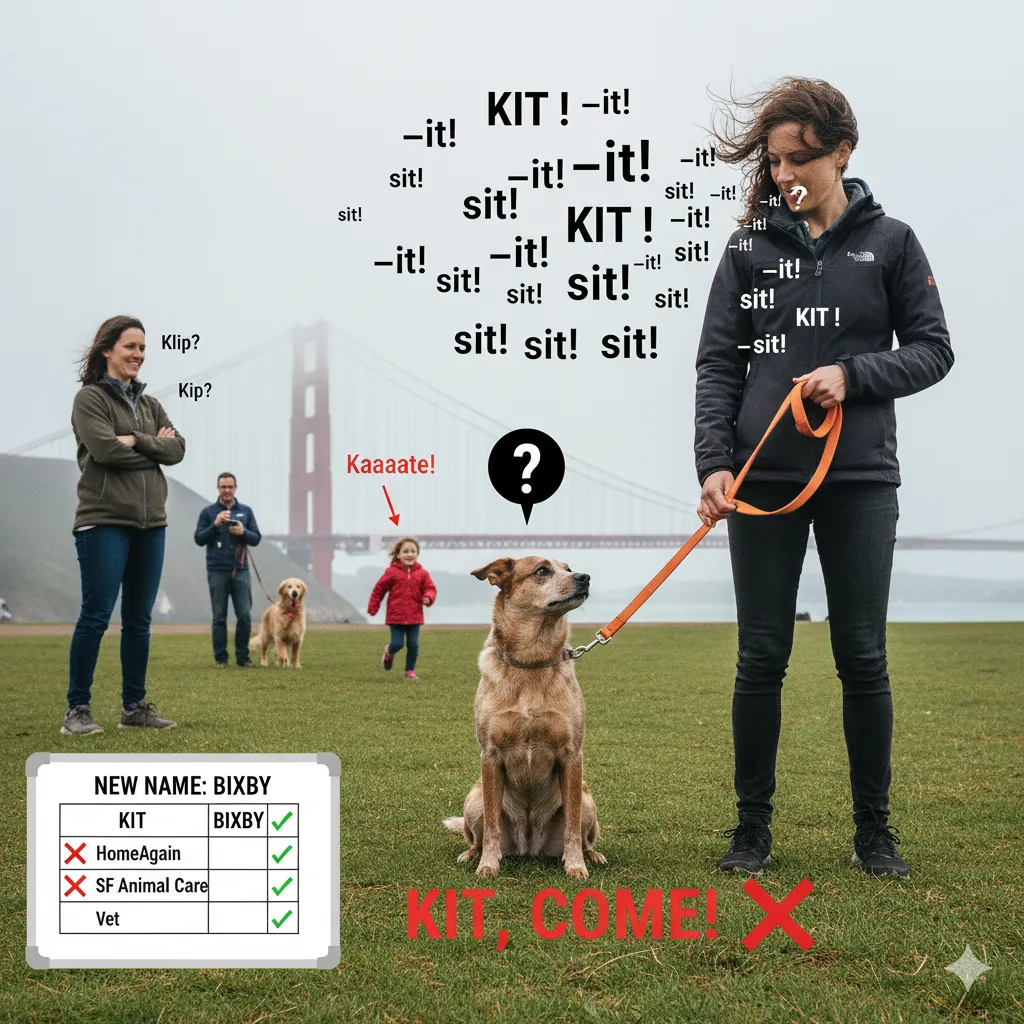
It was 7:10 a.m. at Crissy Field, fog hanging low over the bay and the kind of wind that turns your words into confetti. The cattle-dog mix at the end of Maya’s long line sat beautifully. Didn’t move an inch. She stared at Maya like a straight-A student waiting for the next instruction. Maya sighed. I blinked. The trainer next to me—who’d been politely quiet—let out a small laugh.
“You named your dog a command,” she said.
I felt my stomach drop. I’m the person people call to get this stuff right. They pay me to avoid mistakes like this. And yet there we were, yelling “Kit!” while the dog dutifully “sat.” The wind clipped the first consonant, blurred the vowel, and what reached the dog was a brisk, fog-whipped “—it!” Her brain did exactly what we’d taught it to do for “sit.”
I wish I could say that was the only issue. It wasn’t.
A week earlier, I’d helped Maya and her partner, Alex, choose “Kit.” We liked its quickness. Bright. Unisex. Felt adventurous. We tested it in their living room with string cheese and optimism. It passed with flying colors. What I didn’t do was take it for a spin in the wild—the park, the beach, the chaotic, echoey places where dog names really earn their keep. I also didn’t ask enough about Maya’s daughter, Kate, who was four and had just learned to spell her name. “Kaaaaate!” and “Kiiiit!” might as well be twins to a dog who’s busy deciding which squirrel to chase.
Then daycare called. “We have three Kits, two Kikis, and a Kitty. Would you mind adding a last initial?” Not fatal, but not ideal. Names are not just for the dog. They’re for the people who need to get your dog’s attention fast, without confusion: vets, groomers, daycare staff, park regulars, your neighbors who can’t remember if you said Kip or Kit or Kim.
I tried to salvage my pride and the name. “We can out-train this,” I said, which, if you’re keeping score, is how people get themselves into months of frustration.
The Messy Middle
We went back to the basics: name means “look at me,” not “do anything else.” We charged the name with rewards—tiny hot dog slices, delivered within a beat of hearing “Kit.” We kept it short and happy. It worked in the kitchen. It worked in the hallway. Crissy Field said otherwise.
On day three, we hit another snag. A good Samaritan found “Kit” when she slipped her martingale in a moment of excitement near the water. He scanned her microchip and called the number on file.
“Hi, I found a dog named Jasper,” he told Maya when she finally answered. Jasper was Kit’s shelter name—never updated in the registry. He said “Jasper” to her; she looked away. No name recognition, no recall. Thankfully he was patient, and we connected quickly. But if he’d had to call Animal Care & Control, who would’ve known to ask for a dog named Kit?
In the span of 72 hours, I learned (again, the hard way) that the name isn’t a label; it’s a tool that has to work across environments, people, and systems. And as obvious as that sounds, the trick is proving it under stress.
What I Got Wrong
- I let aesthetics lead function. “Kit” looked and felt right to us, but not to the dog in wind, noise, and distraction. If you’ve ever tried to call “Ray!” across a soccer field while your mouth is full of cold air, you’ll hear why “Ray” too easily becomes “stay.”
- I didn’t map the social soundscape. “Kit” was too close to “Kate,” and also to the trainer’s dog “Kip,” who trains in the same park. Dogs are phenomenal pattern matchers. We made their job harder.
- I didn’t audit for uniqueness in their real life. Daycare, vet, and dog park all had near twins. Choosing a popular name has consequences in crowded places.
- I ignored the digital identity. Shelter name on the microchip, “Kit” on her collar tag, and “K. Dog” in the daycare app. That’s a recipe for a slow reunion if things go sideways.
- I didn’t test for command collisions enough. “Kit/sit” is obvious in hindsight. So are “Bo/no,” “Ray/stay,” “Rum/come,” and “Poe/no.” We didn’t pressure-test it outside.
📝 Resetting the Name
We gathered in Maya’s kitchen and created a simple brief:
- Function: 1–2 syllables. Crisp consonants (K, P, T, B) that cut through noise. Doesn’t rhyme with core cues: sit, stay, down, come, no, heel, drop, off.
- Emotion: A nod to the family’s Big Sur road trip. Friendly, not cutesy. Respectful in public.
- Operations: Available across all systems—microchip, license, vet chart, pet insurance—within a week.
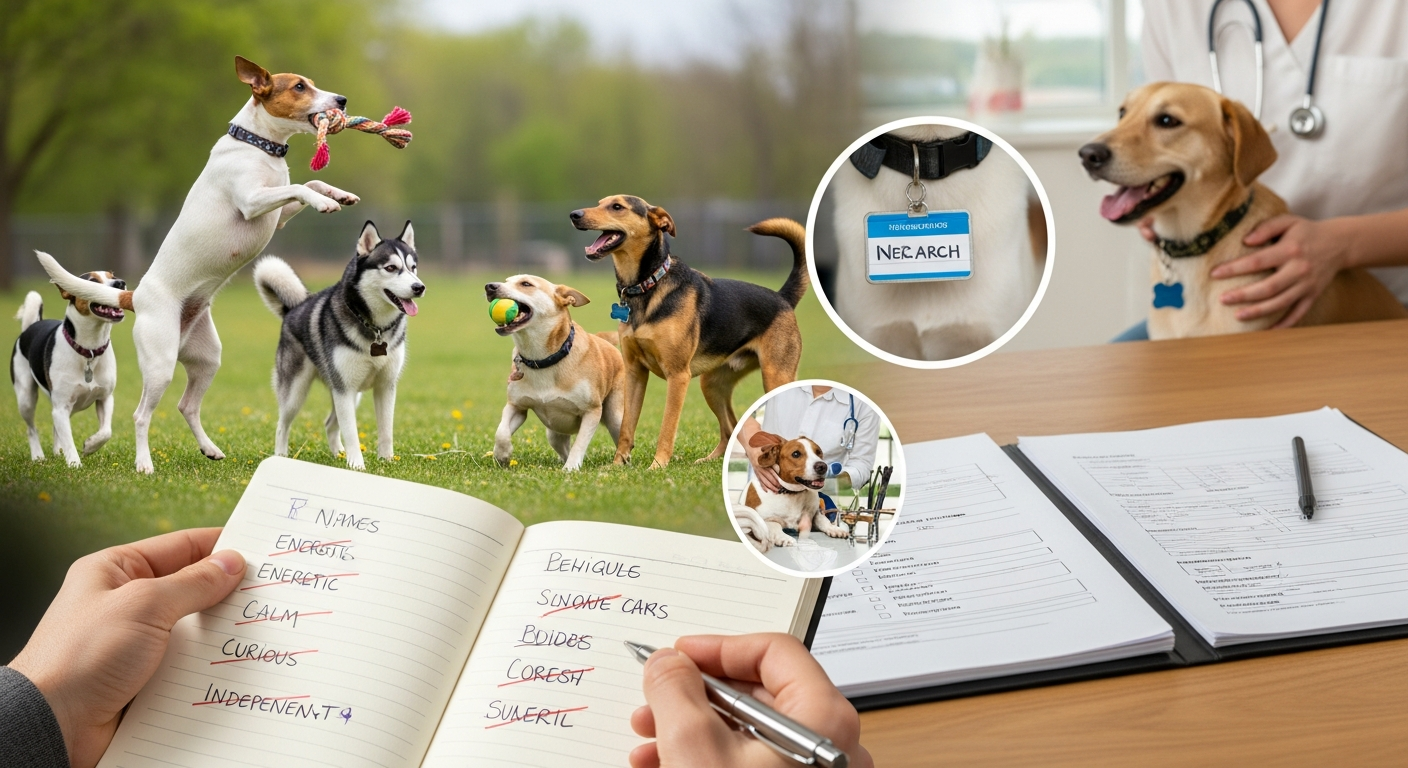
We made two lists: “Names we love” and “Names we can yell in wind.” The second list got shorter fast.
- “Juniper” broke the syllable rule.
- “Echo” was perfect on the page and a disaster with the built-in “no” sound.
- “Bowie” got nixed because “Bo” is a classic “no” rhyme.
We ended up with “Bixby.” It was their favorite bridge along Highway 1, it had two snappy syllables, and “Bix!” felt like popping a champagne cork. No command collision. Not common at daycare.
We did the field tests I should have done first:
- The Hallway Test: Called the name with mixed background noise. “Bix!” traveled. “Kit!” kept collapsing into “sit.”
- The Wind-and-Hoodie Test: Called the name with a hood up and a mask on—real life. Consonants survived.
- The Park Pantomime: Stood 30 feet apart and alternated “Bix!” with “Sit!” They remained distinct.
🎓 How We Taught It
Dog training logic is simple: names are a cue for attention, not an instruction for a behavior. You say the name, the dog looks, you mark and pay.
- Week 1: “Bixby—Jasper” Bridge. For three days, we paired “Bixby” with a split-second pause and “Jasper,” like a hyphen. When she looked, she got paid. Then we dropped Jasper entirely.
- 100 Reps Indoors: Morning and evening, 10–15 reps each. Name, a glance, yes/mark, treat. No repeating the name.
- Real-World Reps: 5-minute name games at the quiet end of the park. If she looked at us when we said “Bix,” we jackpot paid and released her back to sniff.
- Household Alignment: We wrote “Bixby” on the family whiteboard and circled it, adding “No Kiki, no B, no Bixter yet.” Nicknames came later.
💼 Fixing the Paperwork
Maya handled the unglamorous parts that keep a name working when it counts:
- Updated the microchip with HomeAgain (and added a second contact number).
- Updated city dog license through San Francisco Animal Care & Control.
- Called the vet to align records (Jasper → Bixby) so medication labels match.
- Updated daycare and pet insurance.
The Payoff
Three weeks later we went back to Crissy Field. Same wind, same gulls screaming. Maya whistled—her new pre-cue. “Bix!” The dog’s head snapped to her like it was on a hinge. She came in hot and happy.
“It is different,” I said. “You changed the word and what it means.”
🛑 Common Mistakes to Avoid (and what this taught me)
- Don’t choose a name that collides with commands. Test it out loud against sit, stay, down, come, no, off, heel, drop.
- Don’t ignore the environments you’ll actually use it in. Do a wind test, a masked-voice test, a distance test.
- Don’t forget your social soundscape. If your child is named Jake, maybe skip Jax. If your neighbor has a Mo, avoid Bo.
- Don’t pick a name you hate yelling in public. Avoid names that make you cringe when shouted on a busy sidewalk.
- Don’t overcomplicate with long names and instant nicknames. Pick a core name (1–2 syllables) and lock it in for 3–4 weeks.
- Don’t assume popular is harmless. If you go popular (Luna, Max), train an alternate “whistle + name” combo or a unique nickname for crowded spaces.
- Don’t skip the admin. Align the name across microchip (AKC Reunite, HomeAgain, etc.), license, vet records, daycare, groomer, and your pet insurance. Consistency becomes speed when your dog is lost.
What I’d do differently, and what I’d repeat
- I’d start with field tests, not a whiteboard. If the name flops in wind, it flops.
- I’d map the human terrain early. Who’s in the house? Who else says the dog’s name?
- I’d check for duplicates where the dog will spend time: your vet clinic, your daycare, your building.
- I’d repeat the name-bridging method for rescues. Pair the old name with the new for a few days.
- I’d always align the paperwork within a week.
The name isn’t magic; the clarity is.
❓ Frequently Asked Questions
Question 1: Is it okay to change a rescue dog’s name?
Yes. Dogs don’t attach identity the way we do; they attach meaning. Use a bridge for a few days—“NewName (pause) OldName”—and pair the new name with high-value rewards. Most dogs respond reliably within 1–3 weeks. Update the microchip and city license immediately.
Question 2: What sounds make a dog name easier to hear?
Names with crisp, percussive consonants (K, P, T, B) and a strong vowel tend to cut through noise. Two syllables are a sweet spot. Avoid names that rhyme with common cues like “no,” “sit,” “stay,” or “come.” Test aloud in wind and while wearing a mask.
Question 3: Are popular names like Luna or Max really a problem?
They’re not wrong, but they can create friction in crowded U.S. settings like dog parks and daycares. If you choose a popular name, train a unique recall package—whistle + name, or a distinct nickname that few others use.
Question 4: How do I test a name before I commit?
Use a three-part test: (1) Collision check—say the candidate name quickly against sit/stay/down/come/no. If it blurs, toss it. (2) Environment check—go outside in wind or near traffic and test at a distance. (3) Social check—ask your family (kids, grandparents) to say it at normal volume.
Question 5: Do names affect behavior long-term?
Not inherently. What matters is the association you build. If the name predicts good things (attention, treats, praise, freedom), your dog will love responding to it. Think of the name as a “pay attention” chime. Make it worth your dog’s while consistently.
If you remember nothing else, remember this: name choices are small decisions with outsized consequences in the long run. Pick one you can say under stress, teach it like it’s a game, and make sure the whole world—digital and real—knows it, too. Watching a dog whip her head around at her name in a gale off the bay will make you a believer. It certainly made me one.

![Expert guide: The 13 Game-Changing "Should You Rename Your Dog?" Tips That Actually Work [2025] - Related article](https://kkvwzwmtnwoewxanoyzg.supabase.co/storage/v1/object/public/images/images/batch/batch-1762682912681-the-13-game-changing-should-you-rename-your-dog-ti.jpg)
![Expert guide: The 5 Game-Changing Tips That Actually Work: Naming Your Dog for Success [2025] - Related article](https://kkvwzwmtnwoewxanoyzg.supabase.co/storage/v1/object/public/images/images/batch/batch-1762683115480-the-5-game-changing-tips-that-actually-work-naming.jpg)