Transcription Audio
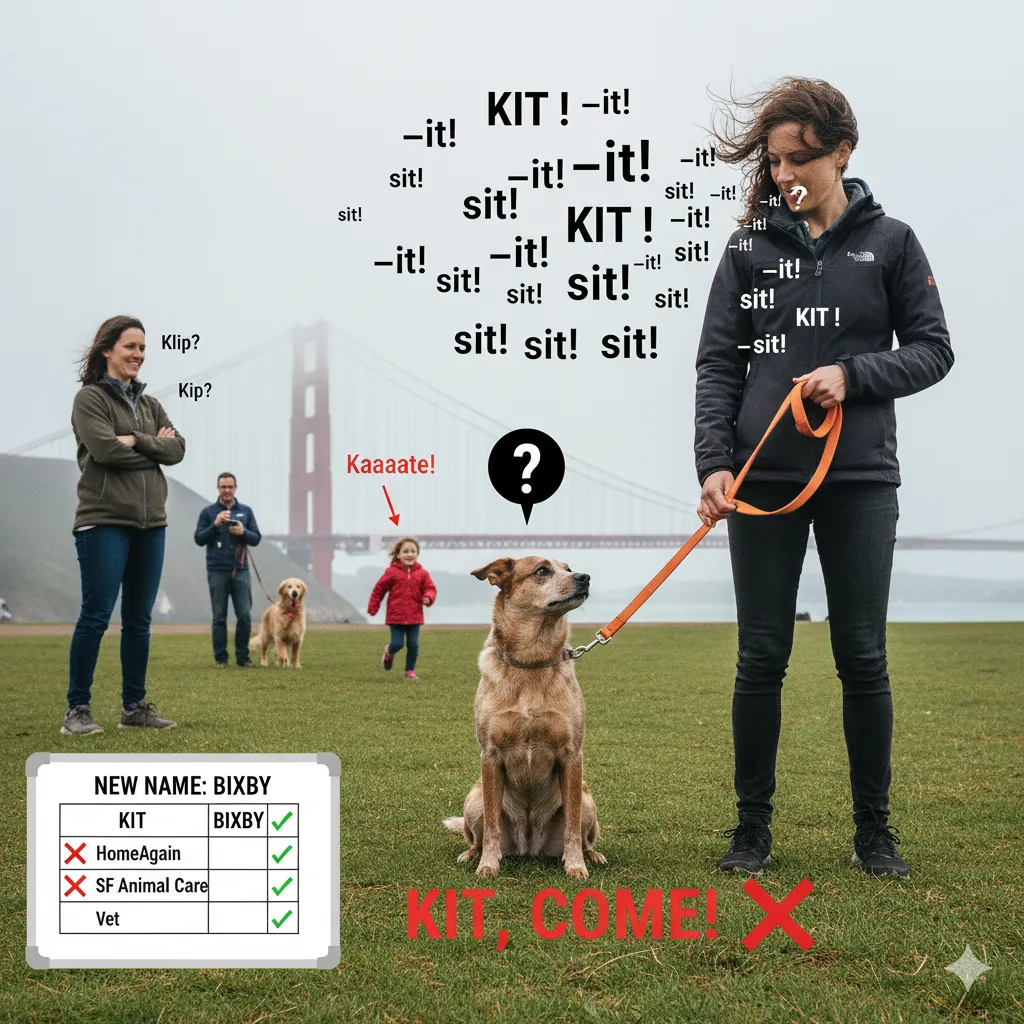
“Kit, come!”
8 novembre 2025
Listen to audio:
Transcript Text
Hello and welcome. Today, a story about a name, a windy beach, and the most avoidable mistake I’ve made as a dog person who should’ve known better. It was 7:10 a.m. at Crissy Field. Fog so low you could taste it. Wind that shredded voices to confetti. My client Maya’s cattle-dog mix sat like a statue at the end of a long line. Perfect sit. Laser focus. We called her name again and again. Nothing. The trainer beside us, very kind, very quiet, laughed and said, you named your dog a command. My stomach dropped. I’m the one people hire to not do that. We’d named the dog Kit. Great name, right? Short, bright, unisex. But in that wind, Kit turned into a blunted “—it,” which sounded exactly like “sit.” The dog was doing what we’d taught her to do. We were the ones not listening. And that wasn’t our only problem. I’d helped Maya and her partner, Alex, pick Kit a week earlier. It tested beautifully in their living room with string cheese and optimism. I didn’t take it for a spin in the wild. I didn’t ask enough about their daughter, Kate, who loved yelling her name in the park. To a dog deciding which squirrel to chase, Kate and Kit are twins. Then daycare called: three Kits, two Kikis, one Kitty—can we add a last initial? Not fatal, but not helpful. Names aren’t just for dogs. They’re for everyone who needs to get your dog’s attention quickly and clearly: vets, groomers, daycare staff, the neighbor who isn’t sure if you said Kip or Kit or Kim. I tried to salvage it. I said the sentence that buys months of frustration: we can out-train this. Then the universe gave us another lesson. Kit slipped her martingale near the water. A good Samaritan caught her, scanned the microchip, and called the number on file. Hi, I found a dog named Jasper, he said. Jasper was her shelter name. We hadn’t updated the registry. He said Jasper, she looked away. No name recognition, no recall, no fast way to connect the dots if he’d had to call Animal Care and Control. We got lucky because he was patient and we picked up. In seventy-two hours, I relearned something I already knew: a name isn’t a label. It’s a tool. It has to work across environments, people, and systems—especially under stress. Here’s what I got wrong: - I let aesthetics beat function. Kit felt right to us, not to a dog in chaos. Ray can become stay across a field. - I ignored the social soundscape. Kit was too close to Kate, and too close to Kip, the trainer’s dog in the same park. Dogs are pattern matchers; we made the pattern messy. - I didn’t audit for uniqueness. Daycare, vet, dog park—near twins everywhere. - I ignored the digital identity. Microchip said Jasper, collar tag said Kit, daycare app said K. Dog. That’s not how you get a fast reunion. - I missed command collisions. Kit and sit. Bo and no. Ray and stay. Rum and come. Poe and no. So we reset. We met in Maya’s kitchen and wrote a simple brief. Function first: one to two syllables, crisp consonants that cut—K, P, T, B—and cannot rhyme with sit, stay, down, come, no, heel, drop, off. Emotion: nod to their Big Sur road trip, friendly but not cutesy, something they’d feel okay yelling in public. Operations: update every system—microchip, license, vet chart, pet insurance—within a week. We made two lists: names we love, and names we can yell in wind. The second list shrank fast. Juniper broke the syllable rule. Echo looked perfect on paper and flopped in real life with that built-in “no.” Bowie got nixed because Bo rhymes with no. We landed on Bixby. Their favorite bridge on Highway 1. Two snappy syllables. Bix pops like a champagne cork. No command collision. Not common at daycare. This time we field-tested first. The hallway test: TV on, kettle whistling—Bix traveled; Kit collapsed into sit. The wind-and-hoodie test: hood up, mask on, turn your head—consonants survived. The park pantomime: stand thirty feet apart, alternate Bix and sit—they stayed distinct. Then we taught it. A name is a cue for attention, not a behavior. Say the name; when the dog looks, mark and pay. Week one, we built a bridge. For three days, we paired Bixby with a tiny pause and then Jasper, like a hyphen. Bixby—Jasper. When she looked, she got paid. Then we dropped Jasper. We did a hundred reps indoors over a week, ten to fifteen at a time: say the name once, get a glance, mark—yes or a click—treat. No repeating the name. Then the real world. Five-minute name games at the quiet end of the park. If she looked at us when we said Bix, we jackpot-paid—handful of yum—and released her back to sniff. The release back to fun is part of the paycheck. We aligned the household. We wrote Bixby on the whiteboard and circled it. No Kiki, no B, no Bixter yet. Nicknames come later, after the core name is bulletproof. And we fixed the boring stuff that becomes thrilling when something goes wrong. Maya updated the microchip through HomeAgain and added a second contact. She updated the city license, called the vet to align records, and updated daycare and pet insurance so every human in the chain says the same word and can reach the right person fast. Three weeks later, we went back to Crissy Field. Same wind. Same gulls screaming. Maya gave a quick whistle—her new pre-cue—and said, Bix. The dog’s head snapped to her like it was on a hinge and she came flying in, happy and confident. Different word, different meaning, different outcome. If you’re naming a dog right now—or your dog’s name isn’t working in the wild—here are the big lessons: - Don’t collide with commands. Test your name out loud against sit, stay, down, come, no, off, heel, drop. - Don’t ignore real environments. Do a wind test, a masked-voice test, and a distance test. - Mind your social soundscape. If your kid is Jake, skip Jax. If your neighbor’s dog is Mo, avoid Bo. - Pick something you can yell in public without cringing. Confidence carries. - Keep it simple. One or two syllables. Lock it for three to four weeks before nicknames. - Popular isn’t harmless. If you choose Luna or Max, pair it with a unique whistle-plus-name or a distinctive nickname for crowded places. - Don’t skip the admin. Align the name across microchip (HomeAgain, AKC Reunite, etc.), license, vet, daycare, groomer, and pet insurance. Consistency becomes speed when your dog is lost. Thinking, can I change my dog’s name? Absolutely. Dogs are language scientists. They learn patterns, not poetry. If a new sound predicts attention and good things, they pick it up fast. Bridge it for a couple of days with the old name if there’s some recognition, then drop the old one. Be disciplined about nicknames at the start. If you’ve got multiple people in the house, get everyone on the same script. Write the name on the fridge. Practice together for five minutes. Make it a game, not a drill. And a tiny nerd note: consonants that cut and vowels that hold help. B, K, T, P, and hard G punch through noise. Open vowels like ah and ih carry better than soft, muddy sounds. If you live in a city, on a farm, or anywhere windy, clarity matters. Your mouth in motion, hood up, head turned—it all changes what reaches your dog. I’ll leave you with this. Your dog’s name isn’t a monogram on a bed. It’s a tool. It should snap your dog’s attention like a seatbelt click, and it should work for the humans who have to say it, spell it, and search for it when it counts. Pick the name you can love in your living room and yell in a storm. Test it where you’ll use it. Make it distinct from your cues. Then teach it like you mean it. If today’s story spares you one windy morning of yelling sit by accident, my embarrassment did its job. Give your dog a name that works everywhere, and watch how much easier everything else becomes.